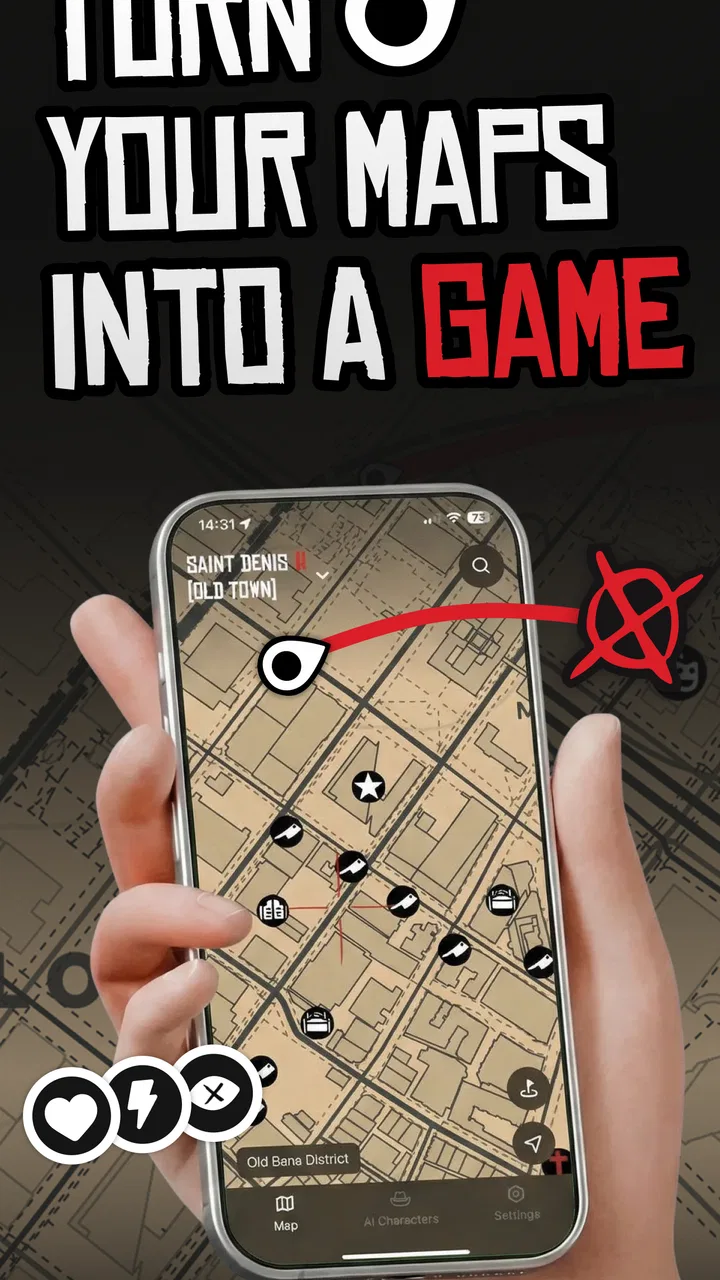
Game Maps IRL
- 4.4
- Rating
- 100.00K
- Installs
- Free
- Price

 Analysis by App-foxy
Game Maps IRL is an unusual Maps & Navigation app from Retry Apps. I approached it less like a replacement for a normal navigation tool and more like a layer that turns ordinary movement into a small real-life mission. That distinction matters: it is not trying to be the app I open when I need the quickest route to an address. Its appeal comes from making a familiar walk, outing, or errand feel more deliberate.
My first impression was that the idea is easy to understand but harder to judge than a conventional map. The short promise, “Game Maps IRL,” points toward playful exploration rather than turn-by-turn driving guidance. In practice, that makes it most interesting for people who enjoy adding a bit of structure to time outside. If you already find yourself inventing walking challenges, exploring unfamiliar streets, or looking for reasons to leave the house, Game Maps IRL has a clear purpose.
The app is free to start, carries an Everyone age rating, and runs on Android devices beginning with version 7.0. Its current version is 2.2, so it is accessible to a broad range of phones rather than being limited to recent hardware. Optional purchases range from $4.99 to $79.99 per item, which makes it sensible to try the basic experience before deciding whether the deeper value justifies spending money.
You May Also Like

 Blood Strike: 2.5 Anniversary
Blood Strike’s Loadouts Turn Every Drop Into a Tactical Gamble
A close look at Blood Strike’s custom loadouts: how fast access to signature weapons reshapes its battle royale rhythm, rewards preparation, and narrows the gap between fights.

 Pandora - Music & Podcasts
Pandora’s Music Is Easy to Start, but Harder to Recover
Pandora’s strength is its low-effort path from a seed to a station. Its weak spot is how much confidence it asks you to place in connection, setup, and quiet recovery.

 8 Ball Pool
 Is Built on Rivalries, Rematches, and Routine
A close look at the rivalries, rematches, shared routines, and unanswered safety questions that turn a quick pool match into a persistent mobile community.

 Samsung Music
’s Quiet Strength Is Playing What You Already Own
Its reach comes less from spectacle than from dependable access to a personal library. That simplicity is both the app’s strongest retention engine and its ceiling.

 AccuWeather: Weather Radar
AccuWeather Review: A Quick, Clear Forecast for Everyday Decisions
For everyday plans, the best forecast is the one you can understand quickly. AccuWeather makes rain timing, radar, and local conditions easy to act on, with a few trade-offs.

 Hill Climb Racing
Why Hill Climb Racing Still Turns Crashes Into One More Run
A tiny car, a bumpy hill and one more upgrade: Hill Climb Racing keeps resurfacing because its simple chaos makes every near-miss feel personal.
More From Our News Desk



Why the first week feels more interesting than a normal map
During the first week, the strongest part of the experience is the change in mindset. A standard map answers a practical question: where am I, and how do I get somewhere? This app is more appealing when the question is, “What can I do with the area around me?” That shift can make a familiar neighborhood feel less static. Instead of opening a map only when I am lost, I can treat it as a prompt for movement and discovery.
I would recommend starting with a small, repeatable area rather than trying to use it everywhere immediately. A nearby park, a walk between home and a café, or a route around a shopping district gives the app enough context to become part of an existing routine. This is also a useful way to judge whether its playful approach fits you. If the idea feels motivating after several ordinary outings, it has a chance of becoming a lasting tool. If it feels like an extra step before every walk, the novelty will probably fade quickly.
A realistic example is a weekend errand that would normally be completely forgettable. I might open a conventional navigation app to reach the destination, complete the task, and return home. With Game Maps IRL, I would instead use the outing as a reason to pay attention to the route and treat the trip as a small mission. The errand remains the same, but the app can give the journey a stronger sense of purpose. That is a modest benefit, yet it is exactly the kind of benefit that can encourage someone to walk instead of taking a short ride.
The app also suits people who dislike the pressure of traditional games. There is no need to sit down for a long session or learn a complicated fictional world before getting started. The setting is the real environment around me, so the barrier to entry is low. I can use it for a short outing and stop, rather than committing to a full play session. That makes it especially suitable for casual players, walkers, travelers, and anyone who enjoys location-based ideas without wanting a heavily competitive experience.
Still, I would not confuse an engaging concept with instant depth. The first few uses benefit naturally from curiosity. Any app that changes the way I look at a familiar place gets an advantage at the beginning. The important test is whether the activity remains satisfying once I understand the basic rhythm. I found that the best early habit is to connect it to something I already do, not to expect it to create a complete reason for going outside on its own.
How I would test it before paying
Because the app is free, I would spend the first several outings checking three things. First, does it make me move more often or notice places I would normally ignore? Second, can I understand what to do without constantly consulting the screen? Third, does the experience remain enjoyable when I am not in a new location? These questions are more useful than judging it from one exciting first session.
I would also avoid making a purchase simply because the concept feels fresh. The available in-app items extend from $4.99 to $79.99 per item, a wide enough range that the decision deserves some restraint. The higher end is difficult to justify for someone who only wants an occasional walking diversion. A regular user may see more value, but only if the app’s recurring activities genuinely fit their routine. The right approach is to identify a specific problem it solves—boredom on familiar walks, lack of motivation, or a desire for playful exploration—before spending anything.
One practical tip is to use it alongside, rather than instead of, your normal map at first. Let the usual navigation app handle arrival, road choices, and time-sensitive directions. Use Game Maps IRL for the exploratory part. This division prevents disappointment and makes the app’s strengths easier to recognize. It also avoids forcing a playful tool to perform the job of a dedicated navigation service.
What remains valuable after the novelty wears off
The month-to-month question is more demanding. A location-based concept can be exciting on a holiday or during the first week, but lasting value depends on whether it supports a habit. In my view, Game Maps IRL has the best chance of staying installed when the user gives it a clear role: a companion for walks, a way to refresh familiar routes, or a light activity shared with friends and family.
Its value is less obvious for someone who wants a conventional utility. If my only goal is to find a business, compare routes, avoid traffic, or reach an address efficiently, a mature mapping service is the better choice. Those apps are designed around dependable information and direct answers. This one earns its place by changing the feeling of movement, not by making ordinary navigation more technically complete.
That difference creates a useful trade-off. Traditional maps reduce friction; Game Maps IRL may add a little friction in exchange for engagement. I might spend more time looking at the map or deciding how to approach an outing, but I may also be more willing to take the outing in the first place. For a person trying to walk more, explore locally, or make routine trips less dull, that exchange can be worthwhile. For someone who values speed above all else, it is likely to feel unnecessary.
The strongest long-term use case is a personal rotation of familiar areas. Instead of expecting every session to be a major adventure, I would revisit a few places and let the app make ordinary movement feel intentional. This is a more realistic habit than constantly searching for new destinations. It also reveals whether the app has recurring value beyond the initial surprise. If the same neighborhood remains usable in different moods and on different kinds of outings, the installation has a stronger reason to remain on the phone.
Families and casual groups may also find a durable use for it, especially when a normal walk needs an extra point of interest. The app can serve as a shared prompt rather than a solitary screen activity. I would encourage users to agree on the outing first and keep phone-checking limited. The benefit disappears if everyone spends the entire walk staring down at a display. Used lightly, the map can support conversation and observation instead of replacing them.
Who should skip it
I would skip Game Maps IRL if I need precise, dependable navigation as the main function. It is not the app I would choose for a time-critical appointment, a complicated driving journey, or any situation where I need the clearest possible route with the fewest distractions. A dedicated navigation app is better suited to those jobs.
I would also be cautious if I dislike location-based activities in general. The real-world setting is not a minor theme here; it is the reason to use the app. Someone who prefers games that work entirely indoors, offline, or without relating play to physical movement may find the concept more interesting in theory than in practice.
Finally, it may not suit users who need a strong reward loop to stay engaged. The app’s appeal depends heavily on personal motivation and the pleasure of turning movement into a mission. If I need constant progression, competition, or a large amount of content to remain interested, I would want to test it carefully rather than assume the unusual premise guarantees months of use.
The maintenance cost is small, but the habit needs attention
One advantage of this kind of app is that maintenance is mostly behavioral rather than technical. The challenge is not learning a complicated system; it is remembering to open the app when a walk or outing begins. That sounds minor, but it is the main reason many novelty-driven apps disappear from a phone. If I do not connect it to a regular activity, I will probably forget it between sessions.
My preferred workflow would be simple. Before leaving, I would decide whether the outing is suitable for a playful map. During the walk, I would check the phone only at natural pauses. Afterward, I would decide whether the experience made the trip better, rather than measuring success by how long I used the app. This keeps it from becoming another notification-driven obligation and protects the real-world part of the experience.
There is also a practical maintenance issue around expectations. A user may install it hoping that every session will feel like a fresh adventure. That is not a sustainable standard for any app built around familiar places. The better expectation is smaller: it should occasionally give an ordinary route a new angle. When I judge it that way, the app has a fairer chance of becoming a useful companion instead of a failed attempt at constant excitement.
The purchase structure deserves the same careful handling. Free access lowers the risk of trying it, but optional items can create a temptation to buy before I know whether the habit will last. I would wait until I had used the app across different kinds of outings and in more than one mood. If it only works when I am already excited to explore, spending more will not solve the underlying problem. If it consistently helps me get outside or makes routine movement more enjoyable, a purchase may be easier to defend.
Its broad device support is helpful for households with older phones, and the Everyone rating makes it easier to consider for mixed-age use. Even so, I would set expectations clearly for younger users: the app should support an outing, not encourage unsafe attention to the screen. Adults should choose suitable places and make sure the mission never takes priority over roads, traffic, weather, or other real-world conditions. That is not a criticism unique to this app; it is an essential rule for anything that combines play with movement outdoors.
Where fatigue appears over time
The main source of fatigue is repetition. Once the nearby area is familiar, the app has to keep giving me a reason to look at it without making the process feel like homework. If the missions or map interactions become predictable, the original spark can weaken. This is the point at which a user needs to decide whether the app still improves an outing or is merely occupying storage.
A second source of fatigue is the tension between play and convenience. When I am in a hurry, I want a map to disappear into the background and get me there. A playful map asks for attention, and that can be welcome during a relaxed walk but irritating during an errand. The right solution is not to use it every time. Treating it as an occasional layer rather than a permanent replacement protects its strongest quality.
There is also a social fatigue risk. If one person in a group enjoys turning every trip into a mission and everyone else does not, the app can make a simple outing feel over-organized. I would use it by agreement, especially with family or friends. The best sessions should feel like a shared reason to explore, not a demand that other people participate in a game they did not choose.
Compared with ordinary map apps, Game Maps IRL is less valuable when information accuracy and efficiency are the priority. Compared with conventional mobile games, it is less convenient because I have to be in the real world and willing to move. Its middle position is both its identity and its limitation. It will not replace either category, but it can fill a gap between them for users who want a reason to explore without committing to a full game session.
One non-obvious trade-off is that the app may be most useful when I deliberately limit it. Using it on every walk can turn a playful prompt into a routine obligation. Reserving it for unfamiliar neighborhoods, low-energy days, or outings that need a little structure keeps the experience fresher. Another is that its success can depend more on the character of the area than on the phone itself. A place with safe, varied routes gives the concept more room to work than an area where movement is restricted or monotonous.
The developer, Retry Apps, has positioned the product in a distinctive space, and the response so far suggests meaningful interest: it holds a 4.4 average from around 88 thousand ratings and has passed 100 thousand installs. Those figures tell me that the concept resonates with a substantial audience, but they do not remove the personal compatibility question. An app can be well received and still be wrong for someone who wants straightforward navigation or a deeper traditional game.
My long-term verdict on keeping it installed
After the first-week curiosity, Game Maps IRL earns lasting space only when it becomes part of a real habit. I would keep it installed if it helped me choose a walk, made familiar routes feel less automatic, or gave a group a simple reason to explore. I would remove it if I repeatedly opened it out of obligation, found myself checking the screen more than the surroundings, or preferred a normal map every time.
My recommendation is therefore specific rather than universal. Try the free version with a regular local outing, use it alongside your normal navigation app, and judge it across several ordinary sessions rather than one exciting day. Do not buy an expensive item until the app has demonstrated recurring value in your own routine. That approach matches the product’s real strength: not replacing a map, but adding a playful purpose to movement.
For walkers, casual explorers, families looking for a light outdoor activity, and people who enjoy turning daily life into a game, this is a thoughtful idea with genuine potential. For drivers, efficiency-focused travelers, and players seeking a deep indoor game, another option will serve better. My final view is that the app earns a permanent place through habit, not novelty. When used selectively and safely, it can make an ordinary outing feel more intentional without demanding a major commitment.
FAQs for Game Maps IRL
01What is Game Maps IRL?
Game Maps IRL is an interactive map-based application designed to connect real-world locations with gaming experiences. Depending on the available content, users can explore game-related places, points of interest, routes, events, or community-submitted locations. Its usefulness depends on the title or map sections supported, so it is worth checking the current in-app catalog before downloading.
02How does Game Maps IRL work?
After opening the app, users can browse an interactive map, search for locations, and inspect available markers or map categories. Selecting a point generally provides additional information, which may include descriptions, images, coordinates, or navigation details. The experience is more convenient when location services and an internet connection are enabled, especially while exploring unfamiliar areas.
03Does Game Maps IRL require GPS or location permission?
The app may request access to your device’s location so it can show your position, help you find nearby game-related places, or support navigation. You can usually deny this permission and still browse maps manually, although some location-based features may not work correctly. Review the permission request carefully and enable location access only if you are comfortable using those features.
04Can I use Game Maps IRL offline?
Offline availability may be limited. Basic map information or previously loaded content could remain visible temporarily, but searches, updated markers, navigation links, and community content generally require an active internet connection. If you plan to use the app while traveling or in an area with weak reception, open the relevant maps beforehand and do not rely on the application as your only navigation tool.
05Is Game Maps IRL free to download and safe to use?
Game Maps IRL may be available as a free download, although certain features, advertisements, optional purchases, or external services can vary by platform and version. Download it through the official Google Play Store or Apple App Store to reduce security risks. Before using public locations, also verify the information, respect private property, and avoid unsafe areas or distracted walking.
Pros
- Turns real-world locations into engaging map-based game challenges.
- Encourages exploration and can make walks or trips more entertaining.
- Simple concept that is easy for new players to understand.
- Useful for discovering interesting places in familiar surroundings.
- Can provide a more active alternative to traditional mobile games.
Cons
- Gameplay may depend heavily on GPS accuracy and a stable internet connection.
- Some challenges may be unavailable or limited in less populated areas.
- Using the app outdoors can drain the phone battery quickly.
- Playing near roads or unfamiliar places may create safety concerns.
- The experience may become repetitive after exploring the nearby locations.

Game Maps IRL
Gallery